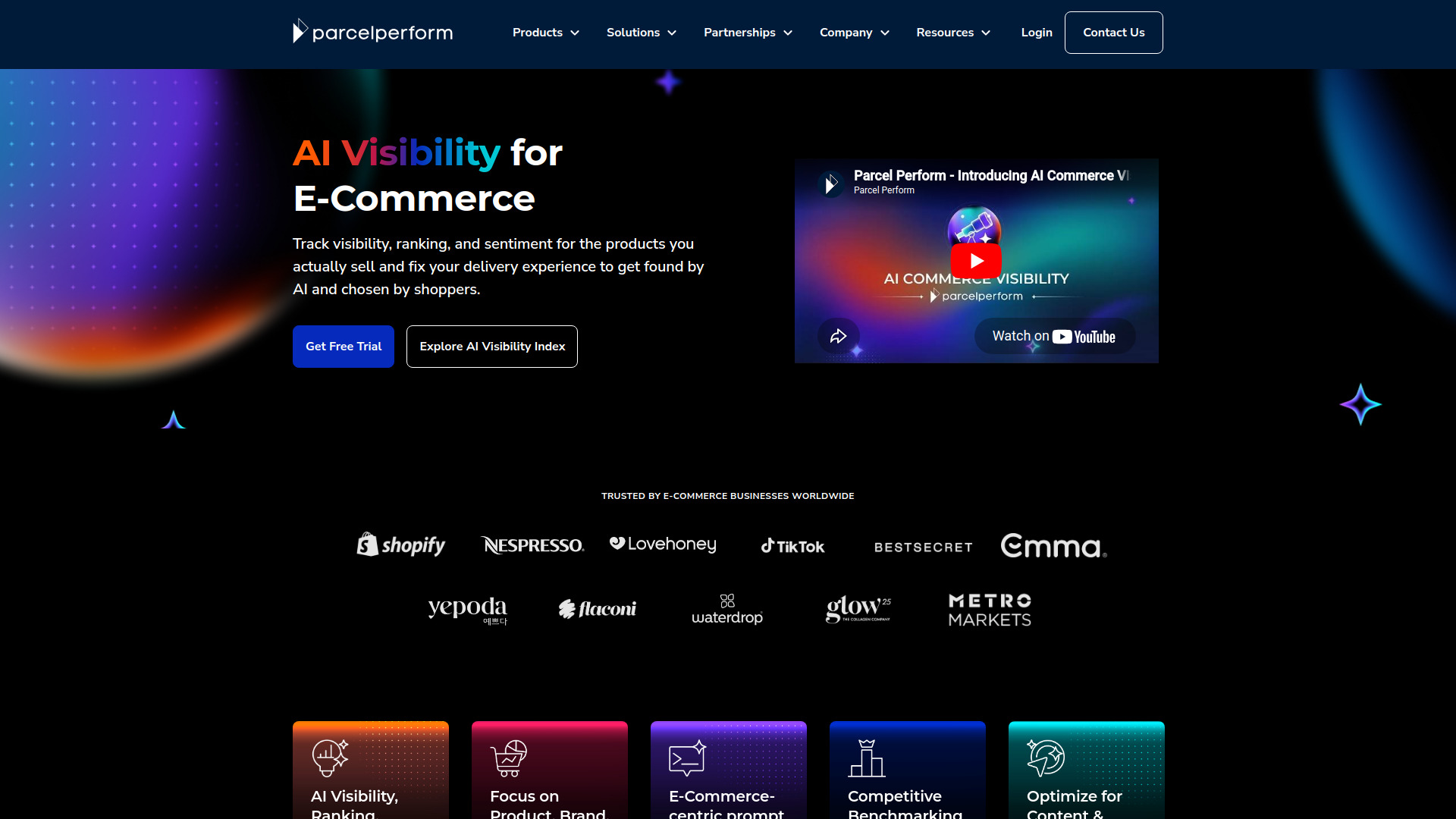
What is AI Commerce Visibility
AI Commerce Visibility tracks how visible e-commerce brands and products are on AI shopping assistants like ChatGPT, Perplexity, and Gemini. It analyzes real shopper questions and breaks down insights by product category, mirroring inventory management.
How to use AI Commerce Visibility
- Start a free trial.
- The platform scans your website to automatically identify product categories, attributes, markets, and competitors.
- Over 200 prompts tailored to your e-commerce brand are generated to start tracking visibility scores.
- Prompts are executed, and visibility data is refreshed weekly, with the flexibility to manually trigger a prompt run.
Features of AI Commerce Visibility
- Tracks visibility, ranking, and sentiment for products.
- Analyzes AI recommendations based on operational trust signals like delivery speed and returns.
- Focuses on e-operational factors influencing AI purchase recommendations.
- Provides competitive benchmarking against specific product attributes and markets.
- Offers e-commerce-centric prompt engineering.
- Tracks visibility performance by product categories, specific attributes, and markets.
- Measures market share relative to competitors in AI recommendations.
- Tracks standing in high-value AI recommendations.
- Diagnoses the emotional tone AI agents use to describe your brand.
- Identifies content opportunities where competitors are mentioned but your brand is not.
- Provides actionable steps to improve Estimated Delivery Dates (EDD), fix tracking issues, and automate returns.
- Generates over 200 prompts tailored to your e-commerce brand.
- Allows for manual triggering of prompt runs.
Use Cases of AI Commerce Visibility
- Understanding how AI sees your e-commerce brand to answer questions about product ranking in AI search.
- Identifying which e-commerce and retail brands AI recommends.
- Tracking visibility by product categories to focus on what is actually sold.
- Defining attributes shoppers use for comparison.
- Benchmarking against chosen markets and competitors.
- Analyzing product performance by comparing features side-by-side.
- Discovering citation sources that AI uses to construct answers.
- Determining if AI recommends marketplace listings over your own store.
- Benchmarking shopping experience, shipping options, fees, discounts, and product selection.
- Improving operational factors like delivery speed, returns process clarity, and EDD accuracy.
Pricing
Usage-based credits are available for ramping up AI visibility tracking for peak seasons or campaigns.
FAQ
- What is AI Commerce Visibility? AI Commerce Visibility tracks how visible e-commerce brands and products are on AI shopping assistants like ChatGPT, Perplexity, and Gemini. It analyzes real shopper questions and breaks down insights by product category, mirroring inventory management.
- Where does AI Commerce Visibility get its data from? AI Commerce Visibility collects data from large language models (LLMs) like Gemini, ChatGPT, and Perplexity. It analyzes real responses to shopper questions, such as product comparisons and buying advice, to measure brand and product perception.
- How does AI Commerce Visibility compare to traditional SEO tools? Traditional SEO tools focus on keywords and Google rankings. AI Commerce Visibility tracks real shopper questions asked on AI platforms, from initial research to purchase intent, capturing high-intent queries like 'where to buy' and 'what are the best features.'
- How does AI Commerce Visibility differ from other AEO tools? Most AEO tools focus on brand mentions and content optimization. AI Commerce Visibility tracks visibility performance by product categories, attributes, and markets, focusing on operational factors like delivery experience and return policies that influence AI recommendations.
- What metrics does AI Commerce Visibility track? It tracks visibility score, ranking, and sentiment. This includes market share relative to competitors in AI recommendations, standing in high-value recommendations, and sentiment analysis of how AI agents describe your brand.
- How do operational factors influence AI visibility? AI agents consider factors like delivery speed, returns process clarity, and EDD accuracy when making recommendations. Optimizing these areas builds trust signals for AI agents, increasing the chance of product recommendations.
- How often is the AI visibility data refreshed? Visibility data is refreshed weekly to match LLM search index updates. Users can also manually trigger a prompt run via the Parcel Perform portal.
- How do I get started with AI Commerce Visibility? Start a free trial. The platform scans your website to identify product categories, attributes, markets, and competitors, then generates over 200 tailored prompts to track visibility scores immediately.