Newsletter
Join the Community
Subscribe to our newsletter for the latest news and updates

AI platform for brainstorming and evaluating product opportunities before building
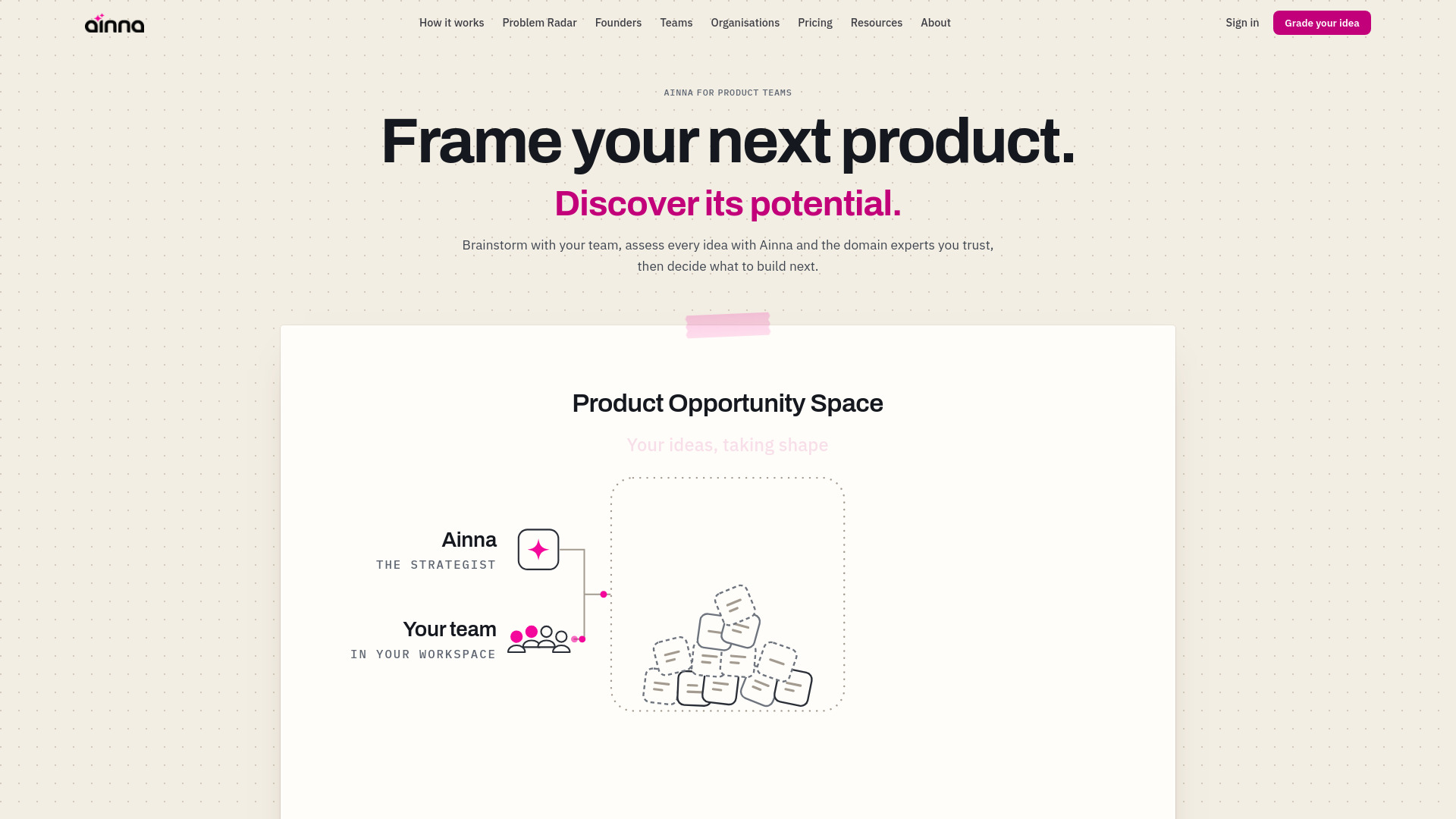
Ainna is an AI platform for brainstorming and evaluating product ideas, helping product teams and founders decide what to build and why before anything is built. It frames opportunities, brainstorms alternatives, profiles users, sizes markets, maps competition, and grades concepts on ten dimensions with reasoning shown. Built on the Innovation Mode methodology (Springer Nature), Ainna combines AI agents with human expert feedback to provide structured opportunity assessment.
What is Ainna, and who is it for? Ainna is AI for brainstorming and evaluating product ideas, helping product teams and founders decide what to build and why before anything is built. It is used by product managers, product teams, heads of innovation, and founders.
How is Ainna different from Jira Product Discovery or Productboard? They organise discovery; Ainna does the discovery work. It frames ideas, brainstorms alternatives, sizes markets, maps competition, grades concepts on ten dimensions with reasoning, and brings in experts to challenge results. What survives becomes a PRD and, on Team, a backlog of prioritised user stories.
How is Ainna different from ChatGPT or Claude? General-purpose assistants give ideas and prose but lack method and are built to be agreeable. Ainna runs the whole method: frames the opportunity, sizes the market against a defensible model, grades the concept on a published framework with reasoning shown, names the dimension holding the grade down, brings in experts, and produces documents from one body of work.
How are product managers using AI tools, and is Ainna an AI agent? Product managers use AI to research and write faster, and increasingly to think better. Ainna is a team of AI agents with one job: deciding what to build. The Strategist frames the problem, the Judge grades concepts, and research agents size the market, map competition, and profile users. You stay in charge with expert verdicts.
How can a product team brainstorm product ideas with AI? Start from a framed opportunity. Brainstorming Mode opens the solution space, develops alternatives, and turns promising ones into concepts. The Judge grades each concept on the same ten dimensions, ending in a ranked shortlist with reasoning shown.
How do I evaluate or validate a product idea? Bring a hunch, feature request, or concept. Ainna frames the opportunity, brainstorms alternatives, sizes the market, maps competition, profiles personas, and puts the concept before the Judge for a grade across ten dimensions with reasoning, the one thing holding it back named, and recommended next move. Experts assess independently, and what survives becomes a defensible case.
What is a product opportunity assessment, and how does the Judge grade? A structured judgment of whether an opportunity deserves the team's time, made before anything is built. The Judge grades on ten dimensions across two lenses: importance of the problem, strategic alignment, effectiveness of the solution, feasibility, ease of implementation, ease of operation, business impact, novelty, and certainty of demand. Each score carries justification, and the dimension holding the grade back is named. Appeals are free.
How do you prioritise features and product ideas? On the same criteria every time, with reasoning written down. Every concept is graded on the same ten dimensions with justification and the one dimension holding it back named, so portfolios rank themselves and anyone can see why one comes first. On Team, work continues into a backlog of prioritised user stories.
How do the experts I trust take part? On the Panel, co-founders, advisors, specialists, or target customers assess the same opportunity independently without seeing the Judge's grade until they give their own. Feedback intelligence sets their views beside the Judge's, showing agreement and disagreement without averaging. The Panel comes with Team and Enterprise; on Pro, the Circle brings in people via a private link.
Can Ainna write my PRD, and which other documents does it produce? Yes. Ainna writes the PRD, PRD deck, executive brief, functional specification, architecture, pitch deck, one-pager, and more from evidence, not templates. It can produce twelve documents in four parts: for the problem, idea, product, and build. All come from one body of work and export as editable PowerPoint and Word files with your branding.
Can I bring my own idea, or start from the Radar? Either. Bring your own idea, feature request, or problem privately, or start from Problem Radar, which scans for problems worth solving and frames each to one standard. Every entry says its source, and news-backed entries link reporting.
How do you write a problem statement as a product manager? Say who has the problem, what it costs them, and why now, leaving the solution out. Ainna asks these questions, pushes back on vague answers, and keeps the framed problem as the reference for grading concepts.
What is a decision log in product management? A running record of significant product decisions with reasoning and evidence. Ainna keeps one as you work: every verdict, pivot, and change of scope, with the reason, attached to the opportunity.
What is an Innovation Agenda, and do I need one to start? An Innovation Agenda is a clearly stated focus for innovation linked to strategy: themes, outcomes, and targets. It is the reference every idea is measured against. You don't need one to start; it becomes useful once more than one idea is in play, as holder fit scores each opportunity against the focus and assets.
How does pricing work, and can I try it for free? Start with a free trial on a real problem, no credit card, including full strategic conversation and a real grade. Pro adds the Circle and full document generation for $99 per month (annual saves up to 20%). Team adds seats, shared workspace, Panel, Innovation Agenda, Market Radar, and ranked portfolio. Paid plans have no hidden fees or lock-in. Larger organisations move to Enterprise. An Opportunity is one problem taken through framing, opening, grading, and documentation; a Brainstorm is one round of opening the solution space. Plan limits apply, and refining or re-grading an Opportunity never uses another.
Who owns what Ainna generates, and is my data used to train AI? You own the ideas, strategies, analysis, and substance in everything Ainna generates. The methodology and document structures remain The Innovation Mode's. Your content is never used to train AI models, never shared, never sold, and never published. It is seen only by you, your teammates when you make an idea discoverable, and your Panel invitees. Hosted in EU data centres under GDPR. Generated documents aren't stored on servers; they are rendered on download. Your work stays until you delete it; accounts with no paid plan and no sign-in for 12 months are deleted after 30 days' notice. Export anytime, delete any idea in one click, close your account whenever you choose.