What is CortexPrism
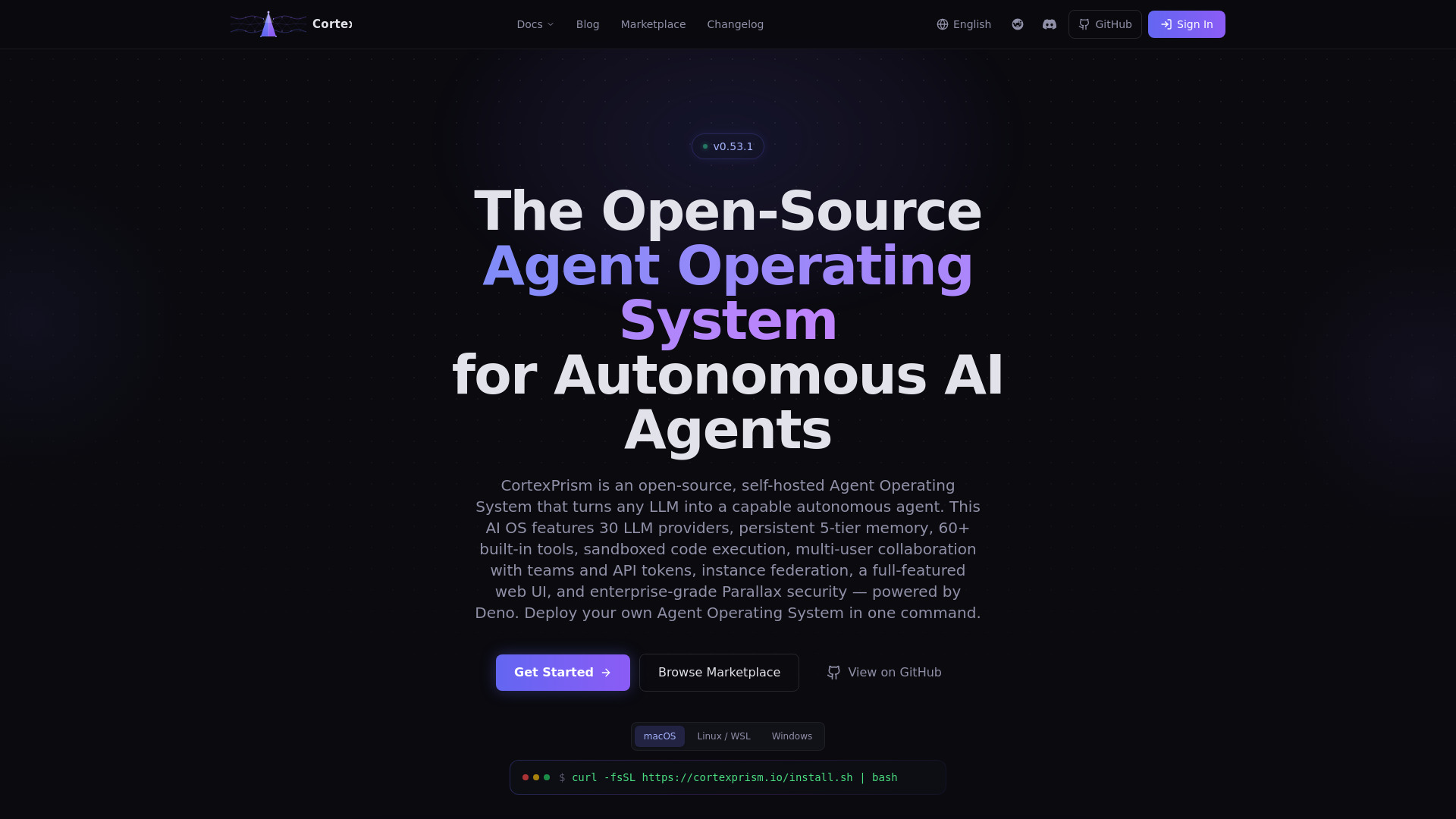
CortexPrism is an open-source, self-hosted Agent Operating System (AI OS) that turns any LLM into a capable autonomous agent. It features 30 LLM providers, persistent 5-tier memory, 60+ built-in tools, sandboxed code execution, multi-user collaboration with teams and API tokens, instance federation, a full-featured web UI, and enterprise-grade Parallax security. Powered by Deno and licensed under Apache 2.0.
How to use CortexPrism
- Install with a single command:
curl -fsSL https://cortexprism.io/install.sh | bash (works on Linux, macOS, Windows, and WSL).
- Start a chat with an LLM provider:
cortex agent chat -m claude-sonnet-4-5.
- Search memory using semantic retrieval:
cortex memory search 'project architecture' --type semantic.
- Run code in a sandboxed environment:
cortex run analyze-data.py -l python.
- Install plugins from the marketplace:
cortex plugins install marketplace:cortexprism.io/plugins/python-executor.
- Use the web UI with dark/light theme and experience levels for managing agents, memory, tools, and collaboration.
Features of CortexPrism
- Interactive Chat with 30 LLM providers including OpenAI, Anthropic, Google, Groq, DeepSeek, and more.
- Tool Use & Approval with configurable approval gates for safety.
- 5-Tier Memory: episodic, semantic, reflection, graph, and skills tiers with hybrid FTS5 + vector retrieval.
- Parallax Security: defense-in-depth with vault, policy engine, and approval workflows.
- Code Sandbox: secure code execution in sandboxed environments (Python, WASM, more).
- Model Router: cascade and threshold model routing for intelligent provider selection and failover.
- Daemon & Jobs: persistent daemon mode with scheduled jobs and background processing.
- Plugin System: extensible ESM/MCP/WASM plugin architecture with marketplace (168 plugins available).
- Git Workspace: full git porcelain with agent-powered commits, diffs, and branch management.
- Model Quartermaster: adaptive 6-signal model selection engine with reinforcement learning.
- Workflow Engine: DSL-based workflows with steps, branching, parallel execution, and approval gates.
- Self-Learning Skills: auto-extracts reusable patterns from tool calls with 6-state lifecycle and trust tiering.
- Code Intelligence: tree-sitter WASM code graph across 14+ languages with call-graph traversal and impact analysis.
- Voice Pipeline: speech-to-text, text-to-speech, energy-based VAD, and real-time audio streaming over WebSocket.
- Computer Use: GUI automation via virtual displays with mouse, keyboard, and screenshot actions.
- Multi-Agent Orchestration: 6 orchestration strategies (sequential, parallel, debate, review-loop, hierarchical, graph DAG).
- Swarm Orchestration: A2A-based distributed node clustering with coordinator, node registry, heartbeat monitoring, and resource snapshots.
Use Cases of CortexPrism
- Building autonomous AI agents that can chat, use tools, and execute code.
- Deploying multi-agent systems with orchestration strategies for complex workflows.
- Enterprise AI agent deployment with team collaboration, API tokens, and federation.
- Self-hosting AI agents with full control over data and security.
- Developing and testing LLM applications with 30+ provider support and model routing.
- Automating software development tasks via git workspace and code intelligence.
- Creating voice-enabled agents with speech-to-text and text-to-speech pipelines.
FAQ
Q: What is CortexPrism?
A: It is an open-source, self-hosted Agent Operating System that turns any LLM into a capable autonomous agent.
Q: How do I install it?
A: Run curl -fsSL https://cortexprism.io/install.sh | bash on Linux, macOS, Windows, or WSL.
Q: What LLM providers are supported?
A: 30 providers including OpenAI, Anthropic, Google, Groq, DeepSeek, and more.
Q: Is it free?
A: Yes, it is open-source under Apache 2.0 license.
Q: What is Parallax security?
A: A defense-in-depth security system with vault, policy engine, and approval workflows.
Q: Can I run code in a sandbox?
A: Yes, CortexPrism provides secure sandboxed code execution for Python, WASM, and more.
Q: Does it support multi-user collaboration?
A: Yes, with teams, API tokens, resource scoping, and federation.
Q: What is the memory system?
A: A 5-tier persistent memory with episodic, semantic, reflection, graph, and skills tiers using hybrid FTS5 + vector retrieval.