Newsletter
Join the Community
Subscribe to our newsletter for the latest news and updates

Unified pay-as-you-go API access to AI models
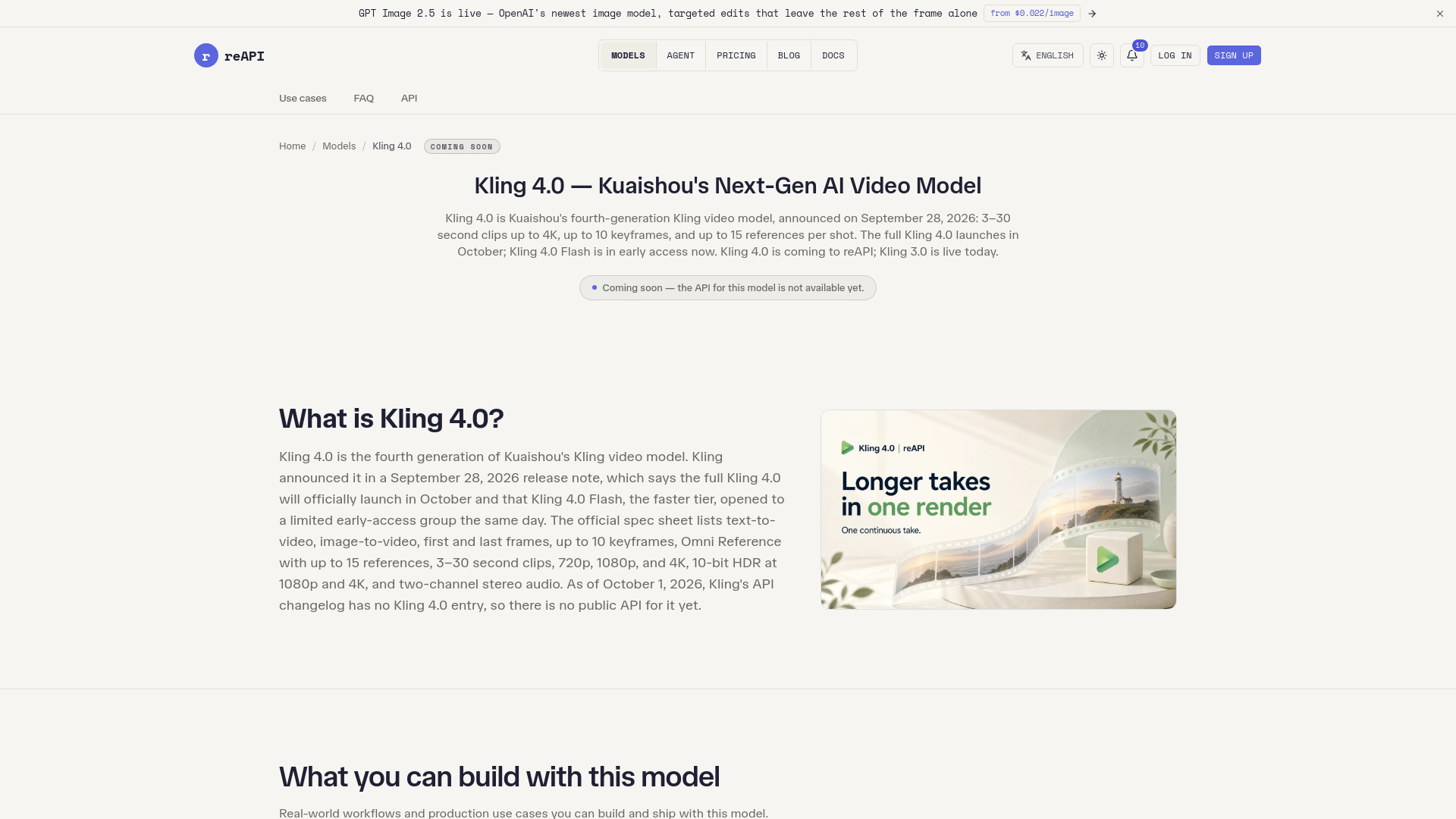
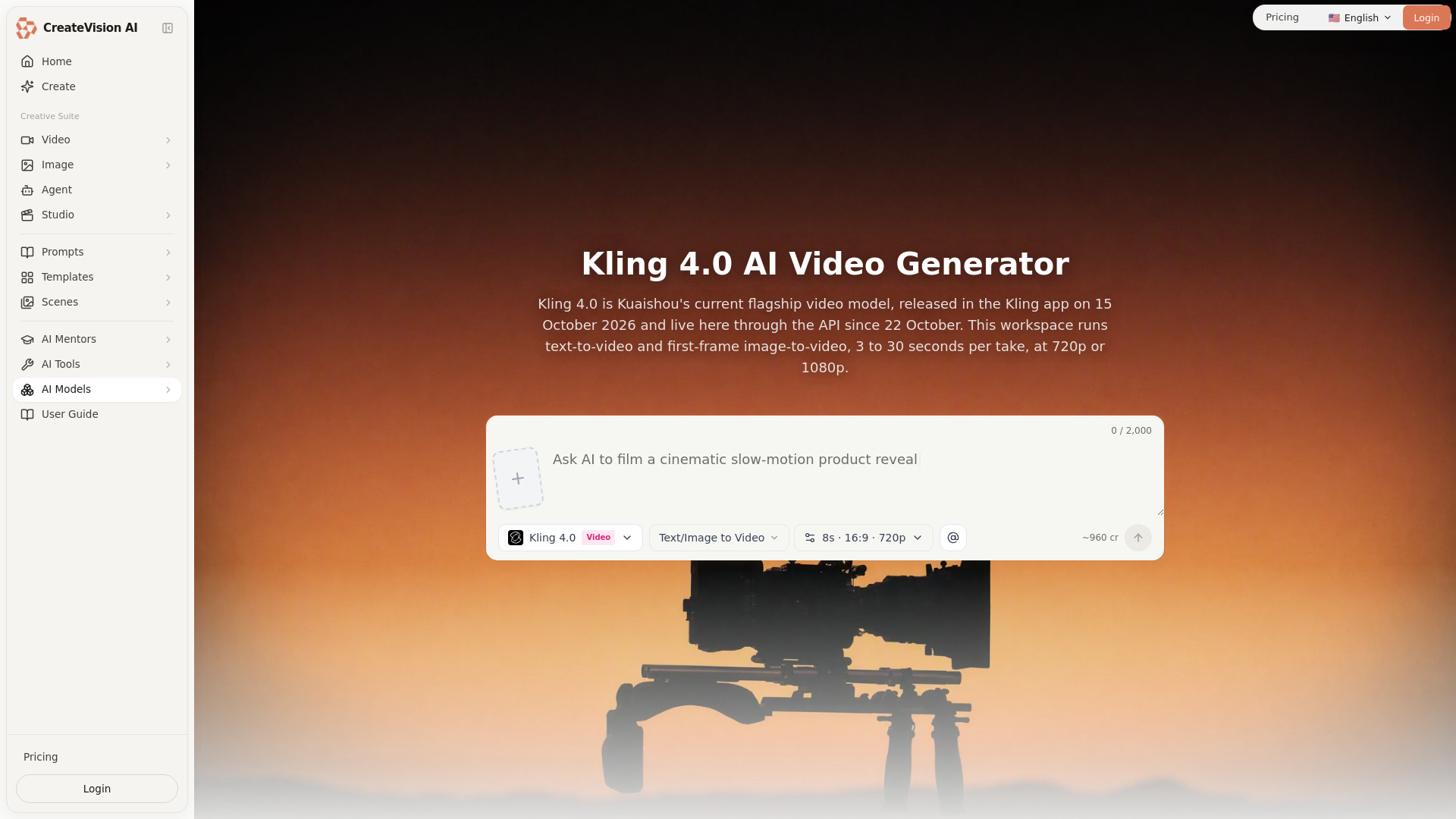
Kling 4.0 is Kuaishou's fourth-generation Kling video model, available on reAPI as a unified pay-as-you-go API. It generates 3–30 second clips with stereo sound at 720p or 1080p from text, keyframes, or image, video, and audio references, and can edit or extend existing videos. Announced on September 28, 2026, Kling 4.0 has been callable on reAPI since October 22, 2026.
/api/v1/videos/generations with model kling-4-0 and the desired parameters (prompt, resolution, duration, aspect ratio, and any media references).GET /api/v1/tasks/{id} every 1–2 seconds until the task completes.Mode is implicit: which media fields you send decides how the request runs. For example, sending only a prompt triggers text-to-video; sending first_frame_image and/or last_frame_image triggers frames-to-video; sending image_urls, video_urls, or audio_urls triggers reference mode; setting omni_reference_task_type to edit with a video_url triggers edit mode; setting it to extend triggers extend mode.
kling-4-0 covers all modes; same API key works across all reAPI models.Credit-based: 1 credit = $0.001 USD. Pay only for completed generations.
A 5-second sample at the cheapest tier costs $0.713 (713 credits). Testing budget guide: $10 ≈ 14 tests, $50 ≈ 70 tests, $100 ≈ 140 tests. No monthly subscription; pay as you go.
What is Kling 4.0?
Kling 4.0 is Kuaishou's fourth-generation Kling video model, following Kling 3.0. On reAPI it generates 3–30 second clips with stereo sound at 720p or 1080p from text, keyframes, or image, video, and audio references, and it can edit or extend an existing video.
When was Kling 4.0 released?
Kling announced Kling 4.0 in a release note on September 28, 2026, with the faster Kling 4.0 Flash in early access the same day. Kling 4.0 has been callable on reAPI since October 22, 2026.
Is Kling 4.0 available through an API?
Yes. On reAPI, send a POST to /api/v1/videos/generations with model kling-4-0 and poll the returned task for the video. The API reference lists every field, mode, and limit.
Is Kling 4.0 free or paid?
Kling 4.0 is paid per second of video at $1 = 1,000 credits. New reAPI accounts get a small test credit, but one Kling 4.0 clip costs more than it covers, so top up before your first generation. Failed tasks are refunded automatically.
Does Kling 4.0 require a monthly subscription?
No. reAPI is pay as you go: you buy credits, each Kling 4.0 task deducts its cost, and unused credits never expire. There is no monthly plan to keep.
How do I get a Kling 4.0 API key?
Sign up at reAPI and create a key under Settings, API keys. The same key works for Kling 4.0 and every other model on reAPI; send it as a Bearer token.
How long can a Kling 4.0 video be?
Each Kling 4.0 generation runs 3 to 30 seconds; the default is 5. In extend mode the duration is the length of the new part, and the result includes the original video.
What resolutions does Kling 4.0 support?
720p and 1080p on reAPI, in 16:9, 9:16, 1:1, or 21:9. Kling's own spec sheet also lists 4K and 10-bit HDR; reAPI does not offer those for Kling 4.0.
How is a Kling 4.0 edit billed?
Edits, and reference requests that include videos, bill at the video-input rate for output seconds plus the longer of the output and the input. The input is the total length of the input videos, rounded up and capped at 30 seconds. Every other mode bills output seconds at the standard rate.
What's new in Kling 4.0 vs Kling 3.0?
Kling 4.0 doubles the clip length to 30 seconds, adds keyframes, takes image, video, and audio references, and can edit or extend a video. Kling 3.0 still offers multi-shot prompts and 4K, so pick it when you need those.
What is Kling 4.0 Flash?
Kling 4.0 Flash is the faster Kling 4.0 tier, in early access inside Kling's app since September 28, 2026. It is not on reAPI yet; the Kling 4.0 Flash page tracks its status.
Can I use my own video with Kling 4.0?
Yes. Set omni_reference_task_type to edit and pass a video of at least 3 seconds to restyle it, or set it to extend to continue it from the last frame. Media inputs are public HTTP(S) URLs.