Newsletter
Join the Community
Subscribe to our newsletter for the latest news and updates

Online AI tool for generating videos from text and images
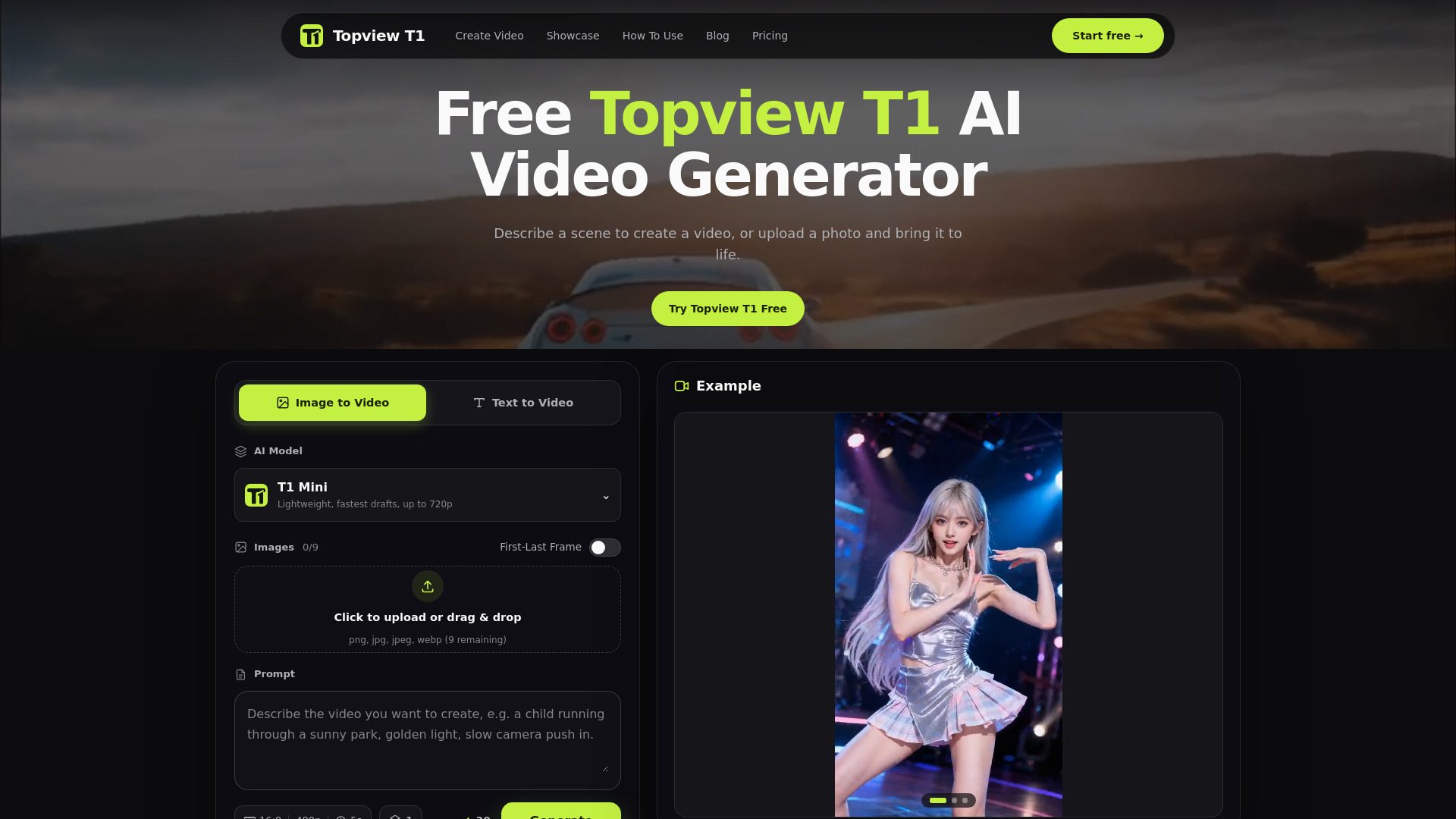
Topview T1 is a video generation model within Topview's wider AI creation platform. It allows users to start with a written scene or an uploaded image and turn that starting point into a video. Topview positions the model as a lower-cost alternative to Seedance 2.5, with comparable quality in its promotional description.
Pro Tip: Separate subject motion from camera movement: “The cup stays on the table; the camera moves closer” asks for a different shot from “The cup slides forward; the camera stays still.”
You can try Topview T1 free on this page. Free access does not mean unlimited generation or that every option is included; review the allowance and any cost shown before generating. A promotion on Topview's own platform does not establish the terms of this page's offer.
Is Topview T1 free to try?
You can try Topview T1 free on this page. Free access does not mean unlimited generation or that every option is included; review the allowance and any cost shown before generating. A promotion on Topview's own platform does not establish the terms of this page's offer.
Should I start with text or an image?
Choose Topview T1 text to video when you need to describe a scene that does not yet have a visual. Choose an image when you already have the subject and composition you want to start from. If a particular product appearance matters, an image gives your request a concrete reference, but the result still needs checking.
How does Topview T1 compare with Seedance 2.5?
Topview markets its model as offering comparable quality at a lower price; that is the company's positioning, not an independent benchmark. Compare results for the same intended shot, looking at subject detail, movement, and how closely each follows the prompt. Promotional price comparisons do not establish the cost of generating on this page.
How can I improve a result that misses my prompt?
For your next Topview T1 attempt, name the visible problem before changing the request. If a still object moves, state which element should remain fixed; if the action is hard to follow, simplify it to one main movement. Keep the other instructions stable so the next result is easier to compare.