What is Lemonade AI
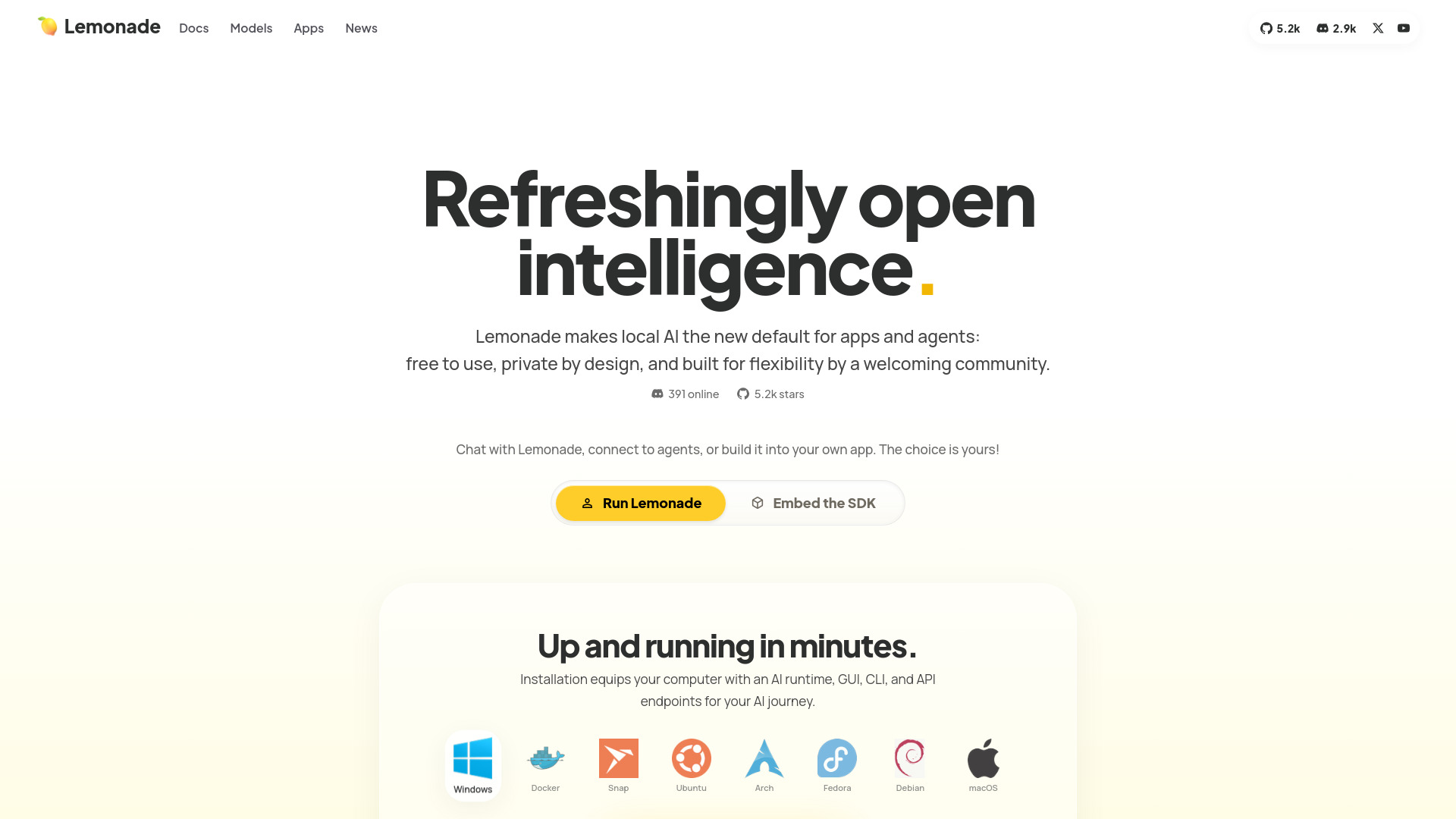
Lemonade is a self-hosted local AI platform that provides text, image, and speech capabilities. It is free to use, private by design, and built by an open community. Lemonade can be run as a standalone application, embedded into other apps via an SDK, or accessed through API endpoints.
How to use Lemonade AI
- Install Lemonade on your preferred platform: Windows, macOS, Docker, Snap, Ubuntu, Arch, Fedora, or Debian.
- Run Lemonade to start a local AI runtime with a GUI, CLI, and API endpoints.
- Chat with Lemonade, connect to agents, or build it into your own app using the Embeddable SDK or API Reference.
Features of Lemonade AI
- Truly open: Free to use, shaped in public, built with a welcoming community.
- Fully private: Transparent, zero telemetry. Data stays where you put it. No upsell.
- Omni modal: Supports chat, vision, image generation, speech, transcription, and embeddings.
- Scalable platform: Local-first on all major platforms; routes to servers and cloud APIs on-demand.
- Weekly releases: New releases every week with continuous innovation.
- Works with great apps: Integrated in many apps and compatible with hundreds more via the OpenAI API standard.
Use Cases of Lemonade AI
- Personal AI assistant: Run a private AI chatbot locally on your computer.
- App integration: Embed local AI capabilities into your own applications using the SDK.
- Agent development: Connect Lemonade to agents for automated tasks.
- Multi-modal applications: Use text, image, and speech AI in a single platform.
- Privacy-sensitive environments: Keep all data on-device with no telemetry or external calls.
FAQ
Is Lemonade free?
Yes, Lemonade is free to use.
Is my data private?
Yes, Lemonade is fully private with zero telemetry. Data stays where you put it.
What platforms are supported?
Windows, macOS, Docker, Snap, Ubuntu, Arch, Fedora, and Debian.
Can I embed Lemonade in my own app?
Yes, Lemonade provides an Embeddable SDK and API Reference for developers.
Does Lemonade support text, images, and speech?
Yes, it supports chat, vision, image generation, speech, transcription, and embeddings.