What is springbrand deepseek harness
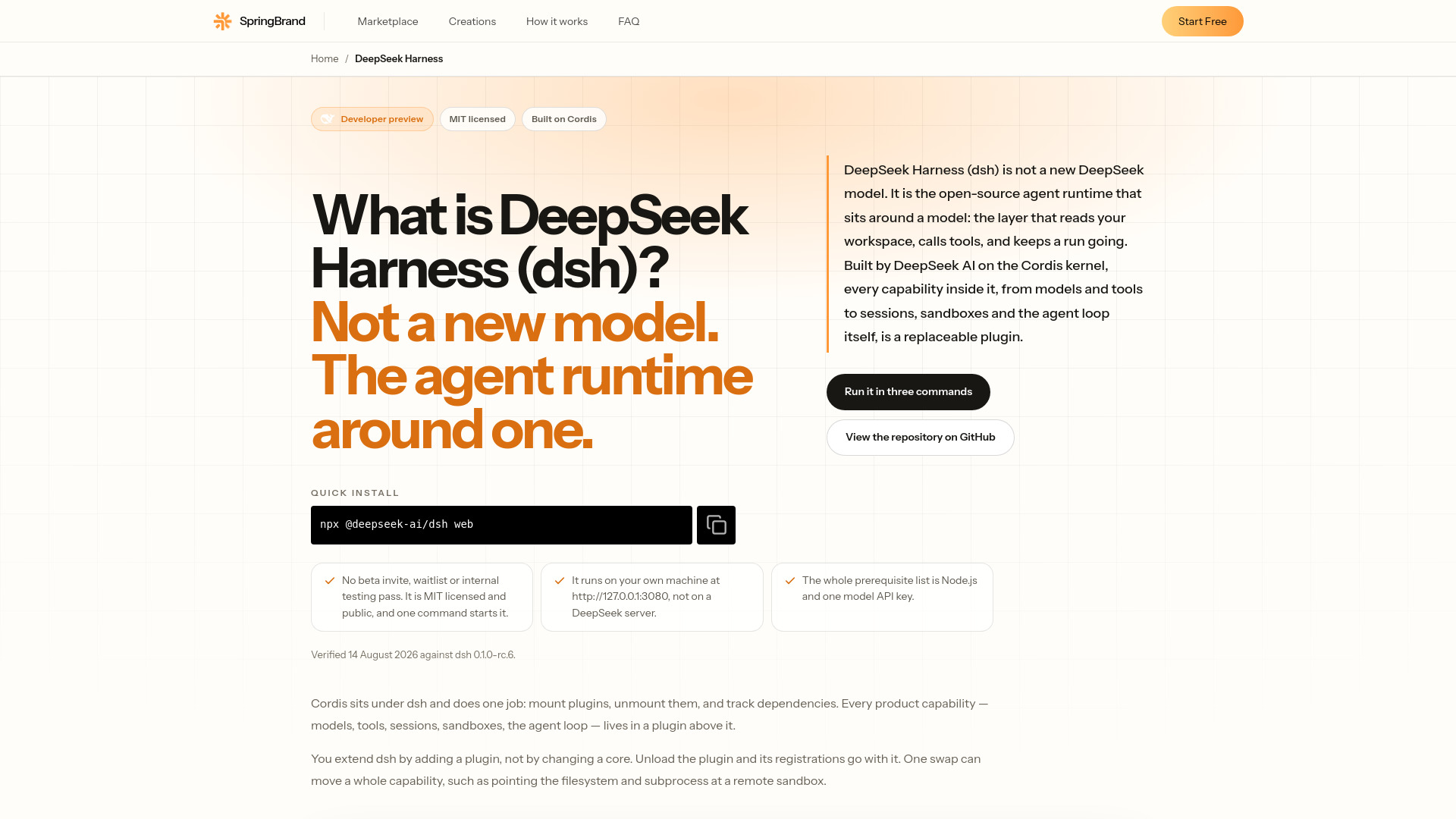
DeepSeek Harness (dsh) is DeepSeek AI's open-source agent harness. It is a framework for building agent harnesses, not a finished coding agent product. The core idea is that an agent is composed of a model plus a harness: the model generates text and decides what to do next, while the harness gives the model a workspace, tools, permissions, and a memory of the run. dsh is built on the Cordis plugin kernel, where every capability—models, tools, sessions, sandboxes, and the agent loop itself—is a replaceable plugin. It is currently in developer preview, MIT licensed, and runs locally on your machine.
How to use springbrand deepseek harness
- Install and start: Run
npx @deepseek-ai/dsh webin your terminal. This starts a local Web UI at http://127.0.0.1:3080. - Prerequisites: You need Node.js 22.19+ or 24+ and a model API key (e.g., DeepSeek, Anthropic, OpenAI).
- Compose the runtime: Load the models, tools, skills, sandbox, storage, and scheduling plugins the job needs. You can start with a preset and swap any capability.
- Describe the outcome: Give the agent a goal, workspace, and operating constraints.
- Trace, fork, and reuse: Inspect the trajectory, branch from any point, and keep successful setups as reusable presets.
- Extend with plugins: Add community plugins using
dsh plugin add <plugin-name>(e.g.,dsh plugin add @liustack/modlens).
Features of springbrand deepseek harness
- Plugin-based architecture: Every capability (models, tools, skills, sessions, sandboxes, storage, agent loops, scheduling, UI) is a plugin, making it fully swappable and extensible.
- Built on Cordis kernel: Cordis manages plugin mounting, unmounting, and dependencies, and dispatches typed events.
- Local-first: Runs on your own machine, not on a DeepSeek server.
- Open source: MIT licensed, public repository on GitHub.
- Web UI and headless runner: Ships a working Web UI and a headless runner for one-shot tasks.
- Composable runtime: Use profiles, bundles, and patch layers to customize the runtime.
- Community ecosystem: Over 421 public repositories under the dsh-plugin topic on GitHub, with plugins for vision, search, file mentions, and more.
- Sandboxing: File-effect confinement for spawned processes with read-only, workspace-write, and full-access modes.
- Session log: Append-only SessionEvent log supporting resume, fork, search, replay, and projections.
Use Cases of springbrand deepseek harness
- Teams that want to own their agent runtime instead of consuming a closed one.
- Plugin authors building and publishing capabilities under the dsh-plugin topic.
- Model evaluation that needs a stable, minimal tool surface across runs.
- Internal platforms embedding an inspectable agent loop behind their own UI.
- Anyone who needs to swap a model adapter, sandbox, or storage backend by configuration.
Pricing
DeepSeek Harness is free and open source under the MIT license. There is no cost for the software itself; you only pay for the model API usage (e.g., DeepSeek, Anthropic, OpenAI) as per your provider's pricing.
FAQ
What is the difference between DeepSeek Harness and a model? The model generates text and decides what to do next. The harness (dsh) gives the model a workspace, tools, permissions, and a memory of the run. dsh does not train, host, or replace a model; it calls whichever provider you configure.
What is Cordis? Cordis is the plugin kernel underneath dsh. It mounts, unmounts, and reconnects plugins, and dispatches typed events. It is a general plugin framework, not specific to DeepSeek or agents.
Is DeepSeek Harness the same as the Python deepseek-harness? No. There are two unrelated projects with the same name. This page covers the official TypeScript project from DeepSeek AI (installed via npx). The other is a community Python client for the DeepSeek V4 API (installed via pip). They are different authors, languages, and problem domains.
Can I run the Web UI on a network?
No. The CLI rejects --host 0.0.0.0 and exits with a usage error. The Web UI is designed to run locally only.
Is DeepSeek Harness production-ready? It is currently in developer preview, with compatibility-breaking changes expected. It is not recommended for production deployments that need API stability today.
How do I install community plugins?
Use the command dsh plugin add <plugin-name>. For example, dsh plugin add @liustack/modlens or dsh plugin add argo-search. Always review the source code of community plugins before installing, as they are not audited by DeepSeek or SpringBrand.