Newsletter
Join the Community
Subscribe to our newsletter for the latest news and updates

Independent guide to Meta's terminal coding agent and coding model
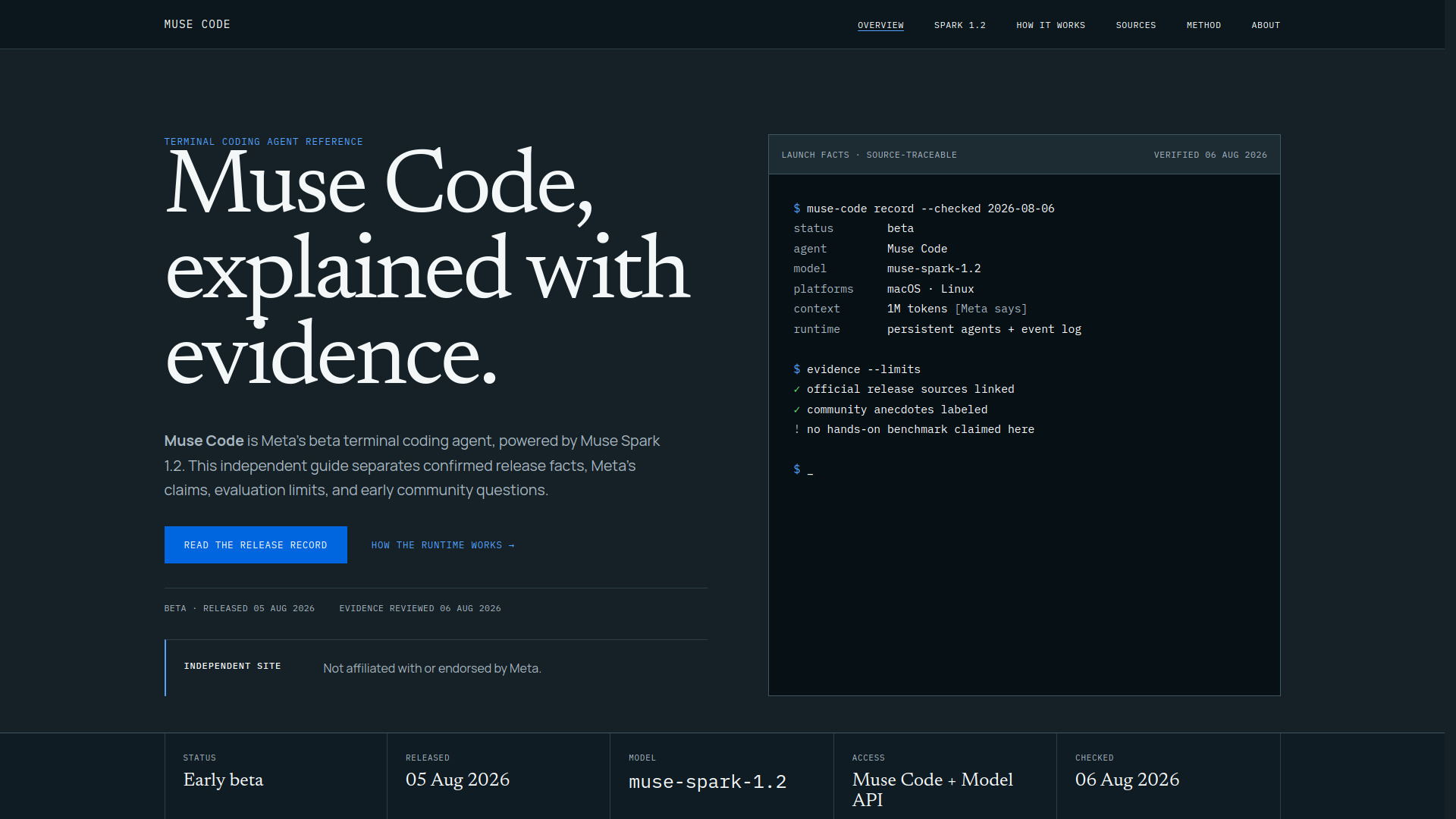
Muse Code is Meta's beta terminal coding agent, powered by the Muse Spark 1.2 model. It plans changes, writes code, validates results, coordinates persistent background agents, and records work in a local event log. The agent and runtime are distinct from the model: Muse Code manages goals, tools, state, worktrees, and the interaction loop, while Muse Spark 1.2 generates model outputs.
muse command to start the agent.As of 6 August 2026, Meta lists standard API pricing for Muse Spark 1.2:
A Contributor tier (model ID muse-spark-1.2-contributor) is token-rate-limited in a rolling five-hour window, available only in select countries, and its data may be used to improve Meta products.
What is Muse Code? Muse Code is Meta's beta terminal coding agent. Meta says it plans changes, writes code, validates results, coordinates persistent background agents, and records work in a local event log.
Is Muse Code the same as Muse Spark 1.2? No. Muse Code is the agent and runtime; Muse Spark 1.2 is the coding-focused model that powers it. The agent manages goals, tools, state, worktrees, and the interaction loop.
Is Muse Code available now? Meta announced an early beta on 5 August 2026 with expanded global access. Access conditions can change, so check the official product page before planning a rollout.
Which operating systems are supported? Meta's research announcement lists macOS and Linux. This guide does not infer native Windows support from that statement.
How do you install Muse Code? Meta publishes a one-line shell installer. Review the official instructions and the script source before executing a remote shell command.
How much does Muse Spark 1.2 cost? As checked on 6 August 2026, Meta lists standard API pricing of $0.15 per million cached input tokens, $1.25 per million input tokens, and $4.25 per million output tokens. Reasoning tokens are billed as output.
What is the Contributor tier? The model ID is muse-spark-1.2-contributor. Meta says it is token-rate-limited in a rolling five-hour window, available only in select countries, and its data may be used to improve Meta products.
Does Muse Code use subagents? Yes, according to Meta. The launch material describes persistent background agents and a fan-out mode where write-capable children can work in isolated git worktrees.
Can Muse Code resume after a crash? Meta says the append-only local event log makes sessions replay-exact and restart-safe, allowing a run to continue from the last recorded step. This guide has not independently stress-tested that recovery path.
Are Meta's benchmark results independently verified? Not by this site. Meta publishes evaluation charts and a methodology report. Independent benchmark projects provide useful context, but scores remain specific to model, harness, effort, environment, date, and cost.