What is Opsis: AI QA & bug detection for vibe coders
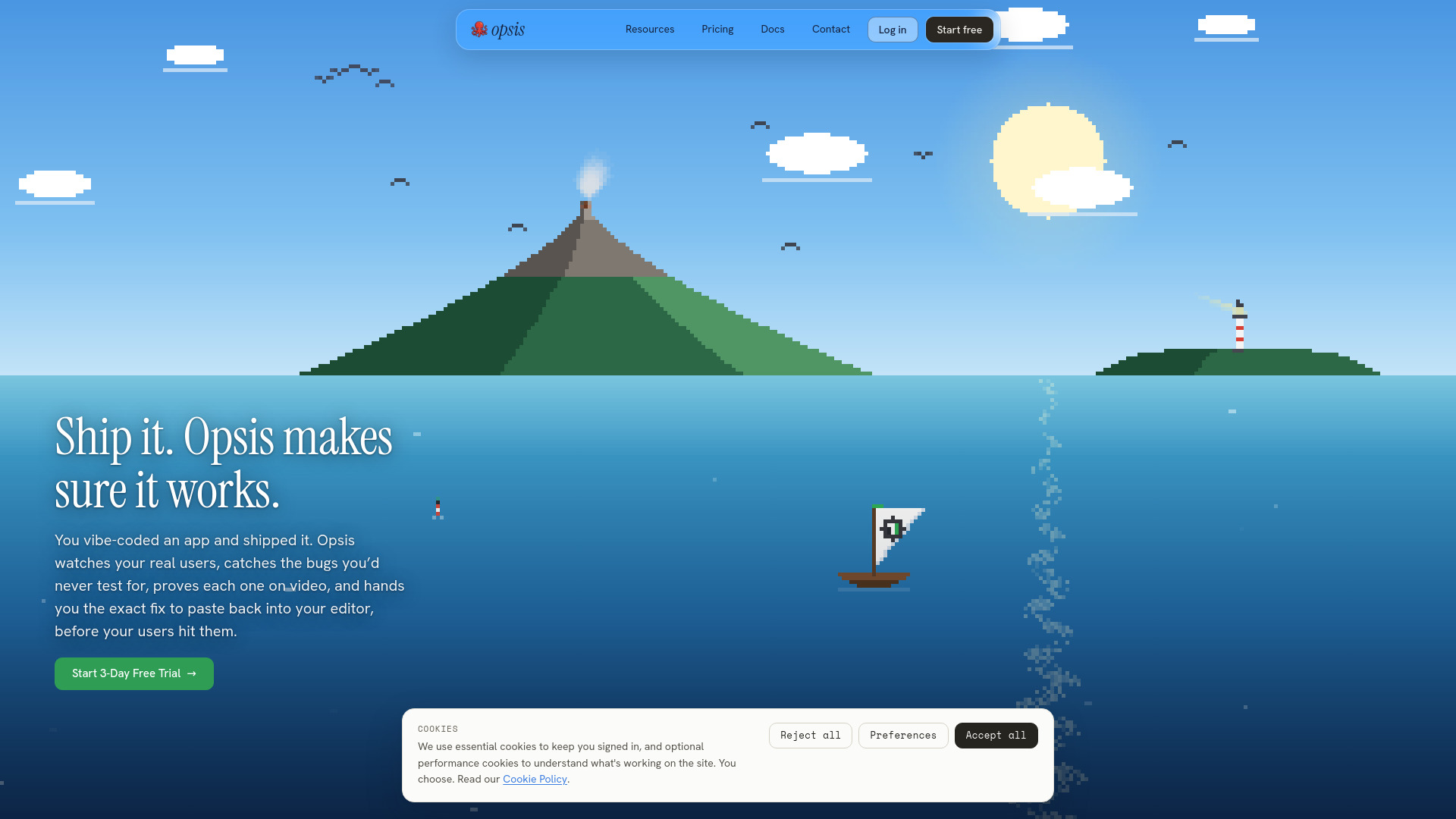
Opsis is an AI-powered QA platform designed for developers who build and ship apps quickly, often using AI coding tools like Cursor, Lovable, Bolt, and Claude Code. It automatically monitors real user sessions, detects bugs that might otherwise go unnoticed, proves each bug with video evidence, and provides copy-paste fixes that can be directly integrated into your editor. Opsis aims to help developers move fast without compromising user trust.
How to use Opsis: AI QA & bug detection for vibe coders
- Connect your app: Integrate Opsis with your existing tools such as PostHog, Sentry, or your own logs to start monitoring real user sessions.
- Automatic detection: Opsis continuously watches user sessions and identifies potential bugs or issues.
- Review bug reports: Each bug is presented with a video proof, a trace, and relevant logs, making it easy to understand the issue.
- Apply the fix: Opsis provides a safe-fix prompt that you can paste directly into your editor (e.g., Cursor, Lovable, Bolt, Claude Code) to resolve the bug.
- Re-verify: After applying a fix, Opsis re-verifies that the bug no longer reproduces, ensuring the issue is truly resolved.
Features of Opsis: AI QA & bug detection for vibe coders
- Real user session monitoring: Watches actual user interactions to catch bugs that traditional testing might miss.
- Video proof for every bug: Each detected bug is accompanied by a video recording, making it easy to see exactly what happened.
- Copy-paste fixes: Provides ready-to-use fix prompts compatible with popular AI coding tools.
- Integration with existing tools: Works with PostHog, Sentry, Slack, Linear, and more.
- PII redaction: Ensures user privacy by automatically redacting personally identifiable information from sessions.
- Scheduled scans and OWASP checks: Helps agencies and freelancers maintain security and catch regressions proactively.
- Re-verification loop: Confirms that a bug is fixed only when it can no longer be reproduced.
- Slack and Linear alerts: Notifies teams immediately when issues are detected.
Use Cases of Opsis: AI QA & bug detection for vibe coders
- Solo builders: If you've vibe-coded an app and shipped it, Opsis watches your real users and catches bugs you'd never think to test for, providing fixes you can paste back into your editor.
- Agencies & freelancers: Manage multiple client launches without the dread of regressions. Scheduled scans, OWASP checks, and Slack/Linear alerts ensure issues are caught early, while PII redaction keeps sessions safe to read.
- Startups & teams: Ship updates without the need for extensive retriage. Every bug comes with video, trace, and logs, and fixes are re-verified before closing.
Pricing
Opsis offers three pricing plans:
- Free plan: $0 per month
- Pro plan: $29 per month
- Team plan: $99 per month
All paid plans come with a 3-day free trial.
FAQ
Q: What tools does Opsis integrate with?
A: Opsis integrates with PostHog, Sentry, Slack, Linear, Datadog, Amplitude, Microsoft Clarity, Google Cloud, OpenAI, Gemini, Anthropic, Atlassian, GitHub, Supabase, Hostinger, Mixpanel, and more.
Q: How does Opsis prove a bug?
A: Opsis captures video recordings of user sessions where bugs occur, along with traces and logs, providing clear evidence for each issue.
Q: Can Opsis help with security?
A: Yes, Opsis includes OWASP checks and scheduled scans to help identify security vulnerabilities.
Q: Is user privacy protected?
A: Yes, Opsis includes PII redaction and read-only OAuth to ensure user data is handled safely and privately.
Q: How does Opsis ensure a fix works?
A: Opsis re-verifies each fix by attempting to reproduce the bug after the fix is applied, ensuring it is truly resolved.